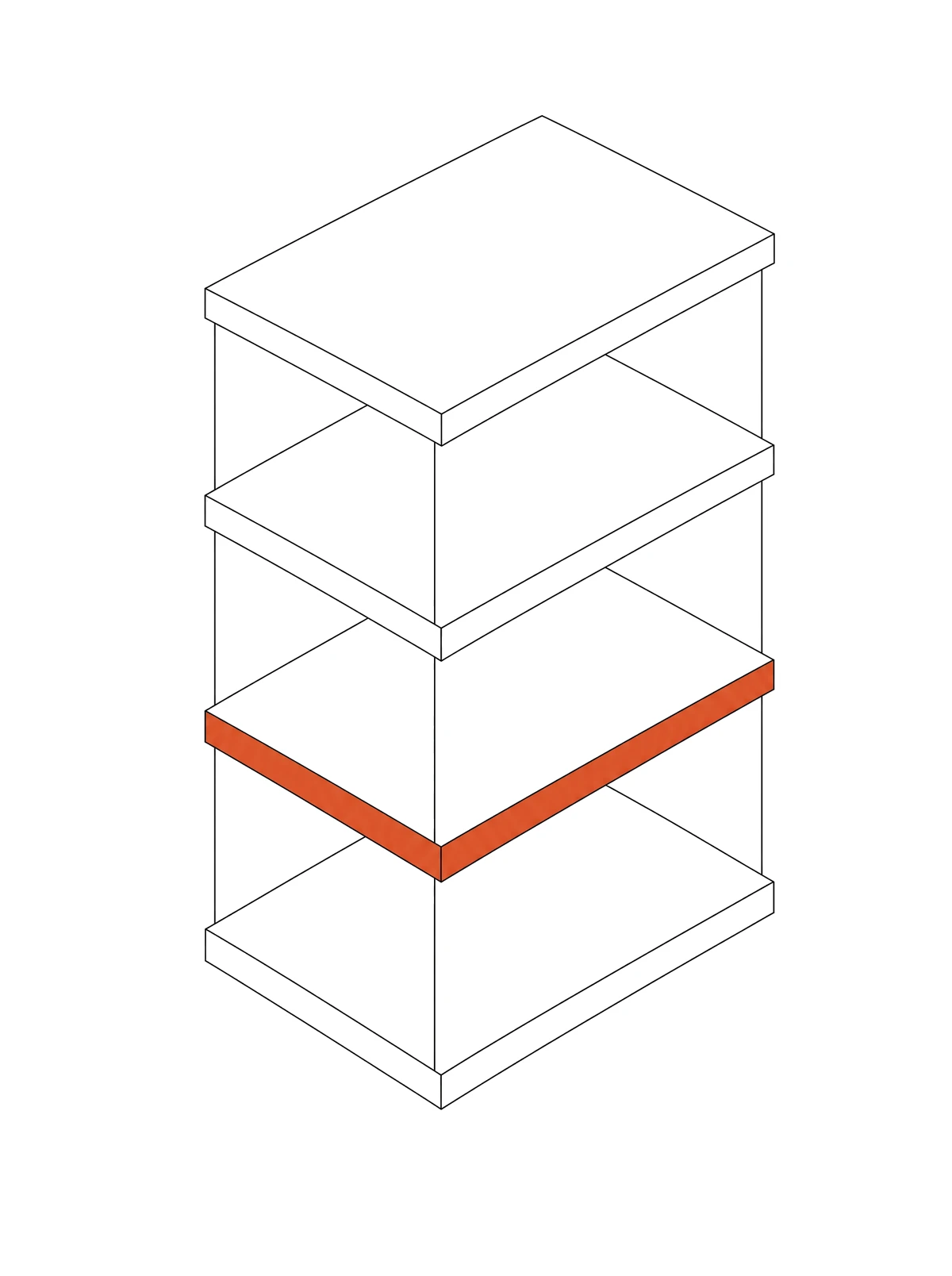
The same four layers; different contents every business.
Four layers, and what goes in.
The same four layers under every build; what goes in them is the conversation.
Built to the operation.
The screens people actually work in.
- iOS
- Android
- Web
- Internal dashboards
- Offline-tolerant
Your logic, made callable.
One source of truth for every app and agent.
- REST
- Webhooks
- Token auth
- Rate limits
- Versioned
Grounded in your records.
It reads your records first; a wrong answer is traceable.
- Retrieval
- Ingest pipelines
- Evaluation sets
- Guardrails
- Human review
The layer nobody buys.
Part of the engagement, not a second budget.
- Managed hosting
- CI / CD
- Monitoring
- Backups
- Patching
Application & device engineering
Native and web applications, the APIs behind them, and AI features built into the architecture rather than bolted on: for product teams, internal teams, and pilots that need to graduate to production.
- Native Android and iOS apps, and responsive web apps
- Internal tools and dashboards that replace re-keyed, manual workflows
- REST APIs, webhooks, auth, and integrations with your existing systems
- AI features on Vertex AI and Gemini: retrieval, evaluation, guardrails
- Pilots and prototypes engineered to become production software
A working app or tool on production infrastructure, typically in weeks, with a deployment pipeline, monitoring, and an owner for the code after launch.
We ship our own native Android app to Google Play today, from one API that also serves iOS and web.
UX & product design
Research, flows, screens, and the front-end that implements them. One team, so nothing is lost between the design file and the code.
- User research, journey mapping, and flows built around how the work actually happens
- Platform-native interfaces: Material 3 and Apple HIG, dynamic color, type scale, accessibility
- Design systems and component libraries your product teams can reuse
- Clickable prototypes in days, ready to put in front of real users
- Front-end implementation on Android, iOS, and web, not just a handoff
Screens that ship. Designed to the platform's guidelines and built by the same people, so the product your users see is the product that was designed.
This site is one design system, designed, built, and run by the same team.
Sales support
The data and tooling that sales and partner teams run on: cleaned, connected to the systems they already use, and reported in one place.
- Lead-generation and enrichment pipelines at scale, delivered CRM-ready
- CRM sync and data operations across Salesforce, HubSpot, Apollo, or custom systems
- Pipeline and partner dashboards with the metrics teams actually track
- Outreach tooling: sequences, templates, and automation with human review
- Pitch collateral, decks, and one-pagers for sales and partner conversations
Sales and partner teams get clean data and working tools in the systems they already use, and a dashboard that reflects the pipeline as it is.
We run our own outbound on this tooling: thousands of leads scraped, structured, enriched, and loaded into a CRM.
Customer support
Support assistants and workflows grounded in your own documentation and records, evaluated before rollout and monitored after it.
- Retrieval-grounded assistants over your product docs, policies, and records
- Ticket triage, classification, and routing automation
- Evaluation harnesses and guardrails before anything reaches a customer
- Support dashboards and knowledge-base tooling for agents
- Monitoring with a route to a human when something breaks
An assistant that answers from your data, not a general model guessing at your domain, with measured accuracy, escalation paths, and a team on call.
The same retrieval, evaluation, and guardrail layers run in our own production AI pipelines today.
Scroll to turn the page
Four layers, and what goes in.
Clients. Endpoints. The AI layer. Data and operations.